
BIOBUZZ game overview
Match timing, scoring, field setup, and the rules that shape a BIOBUZZ robot
BIOBUZZ presented by RTX is the 2026–27 game. Two teams form each . collect yellow POLLEN and their alliance-colored NECTAR, launch pieces into pivoting HIVES, and compete for FLOWER ownership. Pieces in alliance GARDENS and robots parked in LOADING ZONES also score.
Official rules
Check the current manual, Team Updates, and official Q&A before an event. Use the official rule text if a summary leaves something unclear.
Match timing
| Period | Duration | Robot control |
|---|---|---|
| 30 seconds | Pre-programmed behavior; no driver control | |
| Transition | 8 seconds | No powered robot or movement |
| 2 minutes | Driver control |
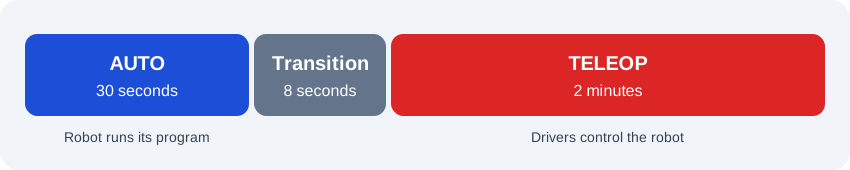
G403 prohibits powered movement during the transition, including a mechanism twitch caused by TELEOP initialization. If causes movement, wait until TELEOP begins to initialize it. G404 also requires powered movement to end when TELEOP ends.
Field setup
The field is approximately 12 feet square. Each alliance has a HIVE with two pivoting CELLS, a GARDEN, and a LOADING ZONE. Four FLOWERS provide shared scoring opportunities. Use the official field drawings and for and .
| Piece | Standard starting distribution |
|---|---|
| 40 POLLEN | Four in each of four FLOWERS; four in each GARDEN; four preloads touching each robot |
| 8 red and 8 blue NECTAR | Three in each alliance's upward-facing CELL; five staged in each ALLIANCE AREA |
POLLEN are approximately 2.8 inches in diameter; NECTAR are approximately 3.6 inches. Their different sizes affect and storage. Championship and Premier Event piece distributions may be modified under §15.2; check event materials.
Starting position
Under G304, each robot starts wholly on its alliance half, touching the perimeter wall, outside the LOADING ZONE, and neither touching nor occupying a FLOWER scoring volume. It must be in its starting configuration and stationary after initialization.
Each robot must contact exactly four POLLEN preloads, wholly on its own alliance half. They can be in or on the robot, or on the tiles touching it; all four do not have to fit inside a magazine. Select and INIT an even if the team will not run AUTO. An AUTO OpMode needs the 's 30-second timer enabled under G304–G305.
Scoring
These are match points. Ranking Points are listed separately below.
| Achievement | AUTO | TELEOP |
|---|---|---|
| LEAVE, per robot | 3 | — |
| PARK, per robot | 5 | 5 |
| Completed HIVE TIP | 20 | 20 |
| Each POLLEN or NECTAR left in an upward CELL | — | 2 |
| Each qualifying piece in an owned FLOWER | — | 2 |
| Bottom NECTAR bonus, per FLOWER | — | 5 |
| Each qualifying piece in an alliance GARDEN | — | 1 |
LEAVE and AUTO PARK are assessed at the end of AUTO. TELEOP PARK is assessed at match end. Final piece scoring follows the manual's assessment conditions after robots and pieces come to rest. A TIP completed before TELEOP starts is assessed as AUTO.
LEAVE and PARK
LEAVE requires the robot to be off the perimeter wall at its assessment. Leaving early and then touching a wall again at the end of AUTO does not earn LEAVE. PARK requires the robot to be at least partly in its LOADING ZONE. The same robot can earn AUTO PARK and TELEOP PARK at their respective assessments.
HIVE TIPS
Launch pieces into the upward-facing CELL. A completed TIP requires the HIVE to change stable states and the previously non-contacting damper to begin contacting the frame. A partial swing or a presumed piece count is insufficient. G417 prohibits inducing or disrupting HIVE motion through other manipulation, such as a held-piece push or deliberate ramming.
There is no universal “load this many balls” scoring threshold in the manual. Piece placement and the HIVE's motion matter. Each TIP can release pieces back onto the field, allowing later collection under G409.
FLOWERS
A qualifying piece is at least partly inside the scoring volume between the top and middle rings. At final assessment:
- The alliance with the topmost qualifying NECTAR owns the FLOWER and receives two points for every qualifying piece there, regardless of who placed it.
- The alliance with the bottommost qualifying NECTAR receives the five-point bottom bonus. It can be a different alliance from the owner.
For example, a FLOWER with five qualifying pieces, blue as its topmost NECTAR, and red as its bottommost NECTAR awards blue 10 ownership points and red 5 bonus points.
G410 specifically prohibits NECTAR entering the FLOWER scoring volume before the final 60 seconds. Use that exact restriction when planning; do not expand its wording to a blanket ban on all POLLEN placement or all FLOWER contact. G418 permits entry through the top and removal of POLLEN only through the bottom. It does not permit deliberate NECTAR extraction.
GARDENS
A piece at least partly in a GARDEN scores for that GARDEN's alliance, regardless of who placed it or the NECTAR's color. GARDENS are not protected zones. The restriction on controlling opponent NECTAR still applies to robots collecting pieces.
Piece control
G407 limits each robot to four controlled pieces total, combining POLLEN and NECTAR. CONTROL can include supported, trapped, or intentionally herded pieces, including indirect contact through other pieces. A four-slot magazine does not prevent a fifth piece becoming controlled elsewhere on the robot.
G408 prohibits CONTROL of opponent NECTAR. Incidental contact and CONTROL are different, but there is no automatic momentary grace period for holding a fifth piece or opponent NECTAR. Brief accidental CONTROL can still violate the rule. Use the current manual for wording.
G409 prohibits catching or deflecting HIVE discharge before it contacts something other than that receiving robot. The stated intent is floor contact before collection. Do not design an intake to catch the spill directly. Incidental deflection is also addressed in the official . Read G407–G410 with the glossary's CONTROL definition when reviewing an intake.
Human loading
Each TIP of an alliance's corresponding HIVE unlocks one additional NECTAR from its five staged pieces. It can be introduced later; immediate entry is optional. At 60 seconds remaining, all remaining staged NECTAR may enter. An own-colored NECTAR that leaves the field may be re-entered under the loading rules without consuming another fresh-piece unlock.
The human must release the own-colored NECTAR so it contacts the tile inside the own LOADING ZONE before a robot or another field element. Do not hand it directly into an intake. TIP-unlocked loading is permitted during AUTO as well as TELEOP under G424–G428.
Ranking Points
A WIN earns 3 RP and a TIE earns 1 RP. Each achievement below adds 1 RP when the alliance meets its threshold:
| Achievement | All other events | Regional Championships | Championship |
|---|---|---|---|
| SWARM | At least 16 combined LEAVE + PARK points | TBA | TBA |
| POLLINATOR 1 | At least 4 TIPS | TBA | TBA |
| POLLINATOR 2 | At least 7 TIPS | TBA | TBA |
Premier Events may choose their own thresholds. Do not assume 16/4/7 applies to a Regional Championship, including Jamaica's championship. Check the event's current requirements and Table 10-3.
AprilTag clusters
BIOBUZZ uses the 36h11 family with 3.25-inch tags. Each CELL carries a four-tag cluster, for four clusters and sixteen distinct tags. They move with the tipping CELLS; these are not stationary wall targets.
| CELL location | Printed IDs |
|---|---|
| Red, opposite audience | 30–33 |
| Red, audience side | 34–37 |
| Blue, audience side | 38–41 |
| Blue, opposite audience | 42–45 |
The SDK's cluster pose can be referenced toward a CELL opening rather than an individual printed tag center. SDK 12 returns distinct single-tag and cluster detection types; check the type before accessing fields. Use the AprilTag programming guide for implementation details. Download practice targets from official field resources; the manual's illustrations are not print-ready targets.
Robot development
For a new team, first test a legal intake, controlled storage, and one repeatable scoring action. Coordinate the task with the alliance partner before adding more mechanisms. Experienced teams can measure complete , recovery time, placement error, and reliability with realistic piece distributions. These are development suggestions, not an official recommended strategy.
Use current CAD for clearances. The illustrated bottom-of-HIVE height is 30.6 inches; this is not the height of the upward CELL opening. Older drawings show 25.5 inches for the bottom, so check which feature and drawing you are measuring.
should track piece count and mechanism state, handle invalid or stale data, and stop safely on a failed move. A measured is useful, but it does not prove an action succeeded. Start with Autonomous, Control systems, and Engineering testing.
For a launcher, start with projectile mathematics and measured stationary shots. Shooting on the move adds release delay, robot velocity, and target geometry once those shots are repeatable.