
Shafts and bearings
Support rotating mechanisms, distinguish live and dead axles, and retain shafts without binding bearings.
A transfers ; a supports motion while limiting unwanted movement. Reliable rotation requires both a way to transmit torque and a way to carry the forces applied to the .
Drive and support
A turns a wheel, but the wheel also carries weight and collision loads. Mounting the wheel far from the adds a bending moment to its output shaft. External bearings can carry that load while a transmission carries torque.
For a simplified overhung load, the bending moment at the support is , where is the perpendicular force and its distance from the support. An illustrative 40 N load at 60 mm produces N·m; moving it to 20 mm reduces that moment to N·m. This is a geometry comparison, not a shaft load rating.
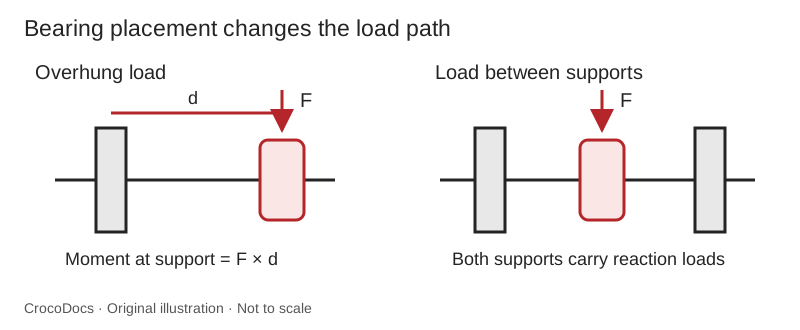
Use the actual gearbox's radial, axial, and torque ratings. Overhung loading and shock loads affect gearbox capacity.
Live and dead axles
In a , the shaft rotates and the is locked to it through a hub, key, hex profile, or other torque connection. Bearings support the rotating shaft in the frame.
In a , the axle stays fixed while the wheel or mechanism rotates around it on bearings. A sprocket, pulley, or gear must drive the rotating component itself. The fixed axle can also connect structural plates when designed for that role.
Shaft interfaces
Check shaft profile and size, bearing inner diameter, bearing outer diameter, housing fit, and hub bore. A nominally round, hexagonal, D-shaped, or REX shaft needs compatible hardware; a near fit is not adequate torque transmission.
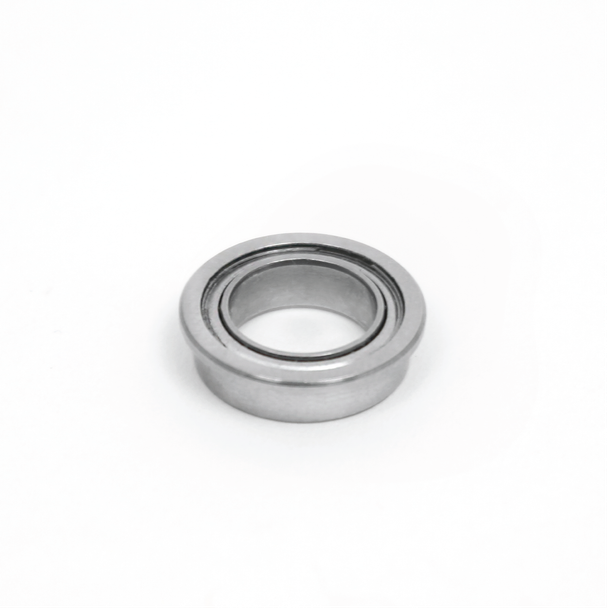
Ball bearings have an inner race and outer race separated by rolling elements. Support and retain the correct races. When installing a bearing with an , apply installation force to the race being fitted, following the bearing supplier's instructions; avoid driving that force through the rolling elements.
Align supports from common . Tightening a pair of plates around a crooked shaft can create friction that looks like a weak motor. Check shaft rotation as each structural joint is tightened.
Axial retention
Axial retention prevents a shaft sliding along its length. Use compatible collars, retaining rings, shoulders, or end screws to constrain both directions. Retain the bearings in their housings too.
Place spacers and shims so a rotating shaft's retention stack bears on the intended inner race without rubbing the stationary outer race or seal. Do not tighten a stack until it binds just to eliminate all visible .
Friction checks
Disconnect power. Where the design permits, remove the belt or chain and compare the supported shaft alone, then add each hub, spacer, and transmission. A tight spot once per revolution suggests runout, a bent part, or an eccentric mount; resistance that appears only after tightening suggests alignment or an incorrect clamping stack.
Mark the position of collars and hubs, run a controlled test, and recheck. Inspect shaft migration, bearing movement, dust from rubbing parts, and loose torque connections. Fix those causes before increasing motor command or retuning control gains.