
Arms and linkages
Size gravity and acceleration loads, support pivots, and understand four-bar geometry and changing mechanical advantage.
An arm positions a load by rotating about a joint. A linkage uses connected members to shape the motion or force between an and an output.
Arm torque
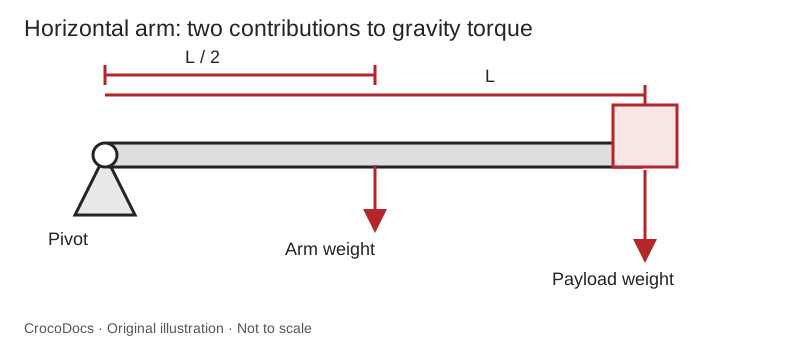
An arm's gravity depends on the horizontal distance from the pivot to each mass. For an arm angle measured from horizontal, a simple load contributes . Horizontal is the largest gravity demand for this model; vertical reduces that contribution.
Include the arm itself, gripper, , and payload. For several masses:
Suppose a uniform 0.4 kg arm is 0.35 m long and carries a 0.3 kg end load. When horizontal, its approximate gravity torque is:
This is a static estimate, excluding friction and acceleration. Starting or stopping requires additional torque , where is rotational and is angular acceleration. Moving mass farther from the pivot increases inertia, often substantially.
Allow for support and shock loads. Size the from rated operating behavior, not alone.
Pivot support and stops
Use a and appropriate to radial, axial, and overturning loads. A belt, chain, or gear can let the transmit torque while separate bearings support the arm. Check the into the .
Use controlled acceleration and deceleration to limit impact at travel endpoints. Motion profiling and gravity compensation can improve behavior after the structure and transmission work correctly. Neither removes the need for protective limits and safe stop behavior.
Counterweights or springs can reduce gravity demand. A counterweight adds mass and inertia; a spring has a force and moment arm that change with position. Compare their effect over the entire travel instead of checking one balance point.
Four-bar linkages
A four-bar linkage has four connected links, including the fixed frame. A parallelogram arrangement can keep the output link at a constant orientation as the side links swing, provided the geometry and stay on the intended branch.
Not every four-bar preserves orientation. Different link lengths produce different paths, and pivots with add error. A virtual four-bar uses a suitably arranged transmission, often belts or chain, to constrain output orientation without the extra parallel physical link.
Compare linkage layouts, then check your exact in and physically. A linkage's output follows a path that may move both vertically and horizontally; reserve its full swept volume.
Mechanical advantage
For a linkage, an actuator force produces torque through its perpendicular moment arm. Near a position where links align, small geometry changes can create large force requirements or a difficult reversal. An over-center arrangement may resist but must be deliberately designed with a recovery path.
For a simple driven arm, a point at radius has tangential speed and a perpendicular force corresponds to . These relations help explain why a longer horn gives more motion but less available force at its tip.
Loaded testing
Support the mechanism, start with small commands, and check stow, pickup, transfer, and placement positions with the intended payload. Record current, settling, deflection, and any point of binding. Keep people outside the swept volume and support the arm before removing power if gravity can move it.
Compare measured holding effort against angle. Unexpected peaks can expose friction, an incorrect center-of-mass estimate, cable pull, or linkage geometry. Resolve those causes before increasing control gains.