
Blu Cru
The 2026 Goodall Division Inspire winner's mentor learning, design analysis, and software recovery paths.
Blu Cru, team 6417, won the Goodall Division Inspire Award at the 2026 Championship. Its DECODE connects member learning to design and uses diagrams to explain and driver controls.
Learning put to use
Pages 3 and 8 describe skills the team wanted to develop, the people who helped, and the work members did afterward. Manufacturing, vision, and design analysis appear again in the engineering pages, so the training has a visible result.
Page 10 brings that work together in a design process: requirements, ideas, , , simulation, and testing.
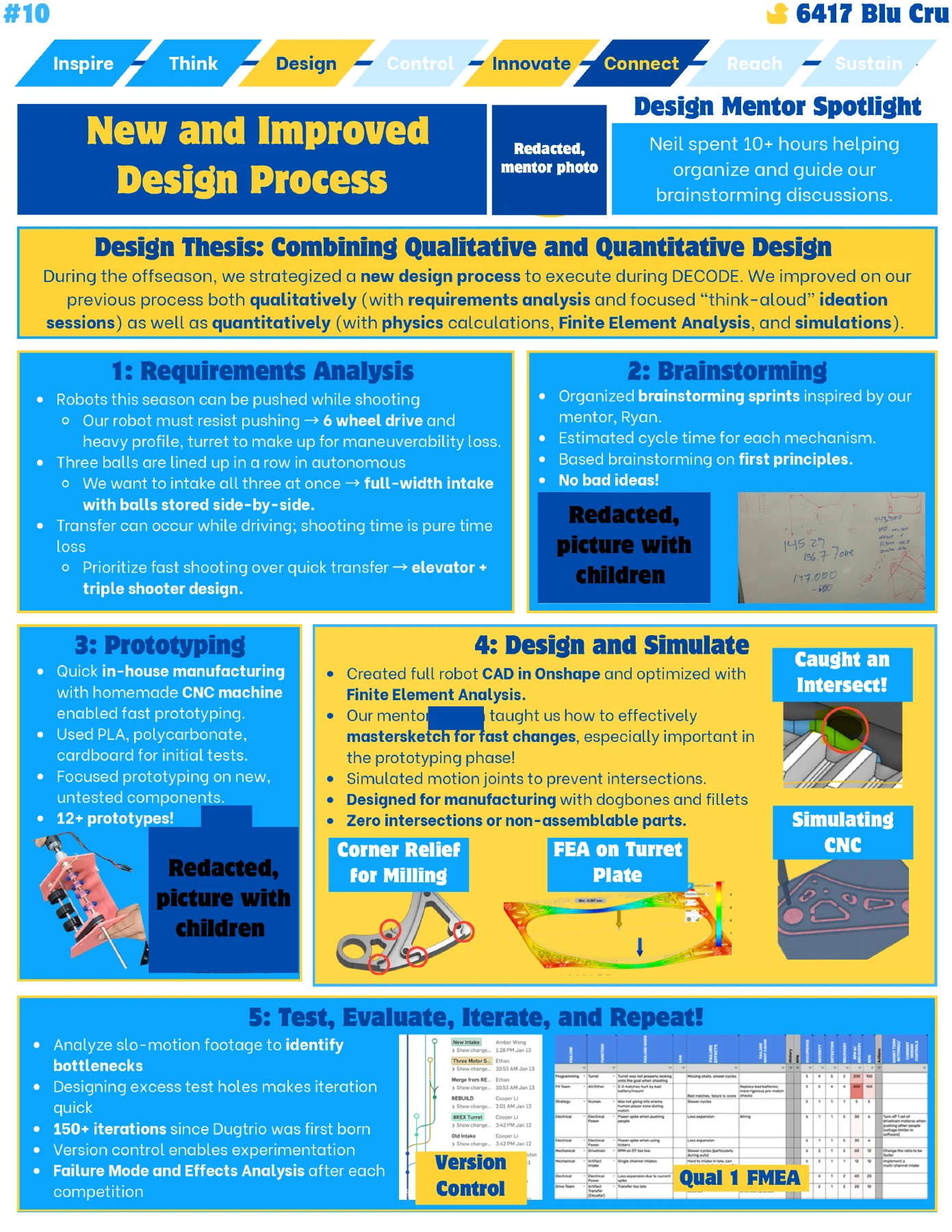
Examples such as corner relief for milling and a fixture for a thin plate show how the team applied manufacturing knowledge to real parts. These details give the learning story something concrete to point to.
In your portfolio, follow one skill through to a finished task. Explain what a taught, then show what a student made or changed with that knowledge.
Mechanism development
Pages 11–13 place drawings and calculations beside the mechanisms they explain. The transfer page follows several linkage versions; the launcher page connects a calculation to the operating range the team was considering.
The explanation stays close to the design question. A reader can see the mechanism, the problem being worked on, and how the analysis helped. Use the same arrangement when a calculation helped your team choose a ratio, size a part, or change a mechanism.
Driver controls and recovery
Page 15 uses a state diagram to show the normal driver , with routes to manual control and a failsafe. The aiming explanation beside it shows how an initial estimate from robot position is refined with camera feedback.
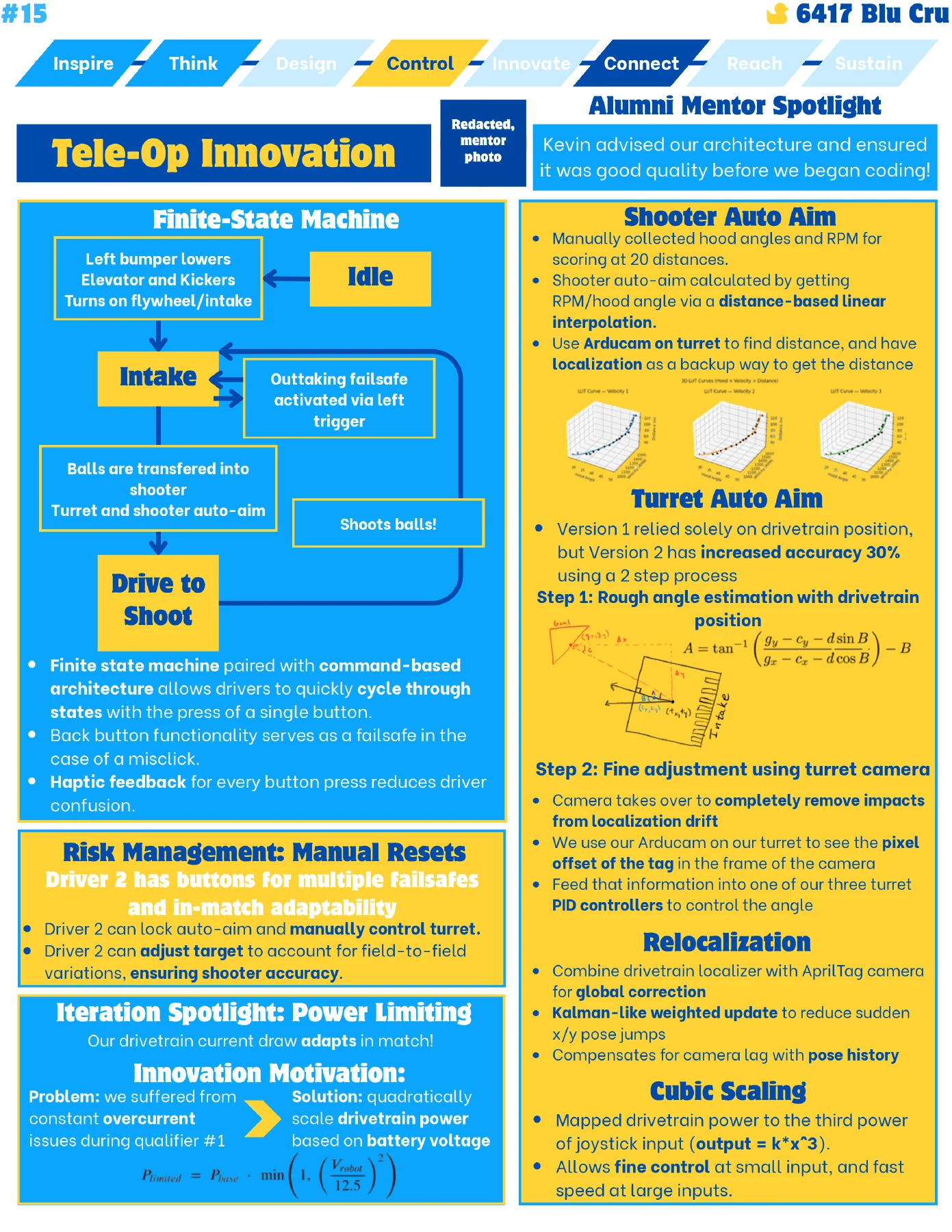
The diagram makes the sequence easier to follow than a long block of code. Arrows show what starts an action, what happens next, and how a driver can recover when needed.
For your robot, draw the normal sequence first. Add the checks and manual controls that change it, then explain how you tested those paths.
Use the examples
Choose a detail to explain in your draft:
| From this portfolio | Record to gather from your team | Continue with |
|---|---|---|
| Learning followed by a design task | The advice received and a student's drawing, prototype, or revised part | Team development |
| Analysis beside the mechanism | The design question, inputs, assumptions, result, and physical test | Engineering |
| Driver states and recovery branches | The implemented triggers, automatic actions, overrides, and their tests | Programming |
Draft the explanation around that record. A reader should be able to point from the statement to the relevant work, then explain the decision in their own words.