
Team development
Explain member learning, STEM partnerships, finances, leadership, and plans for the team's future.
Show how members learn, how the team pays for its work, and how new people take over when older members leave. Use examples from the to explain the plans your team follows.
Member learning
Choose a skill a student learned and show what they could do afterward. That might be a part they designed, code they wrote, or a workshop they led.
For , the steps might be guided practice, a , an independently designed part, and a design review. Use steps that suit your members and show which ones they have completed.
Seattle Solvers shows training followed by growing responsibility. Your team can use the same idea with its own size, schedule, and learning goals.
Follow a skill into independent work
Seattle Solvers' DECODE page 3 arranges learning into stages, from introductory training to hands-on projects, independent tasks, and leadership. Examples beside those stages show what growing responsibility means in practice.
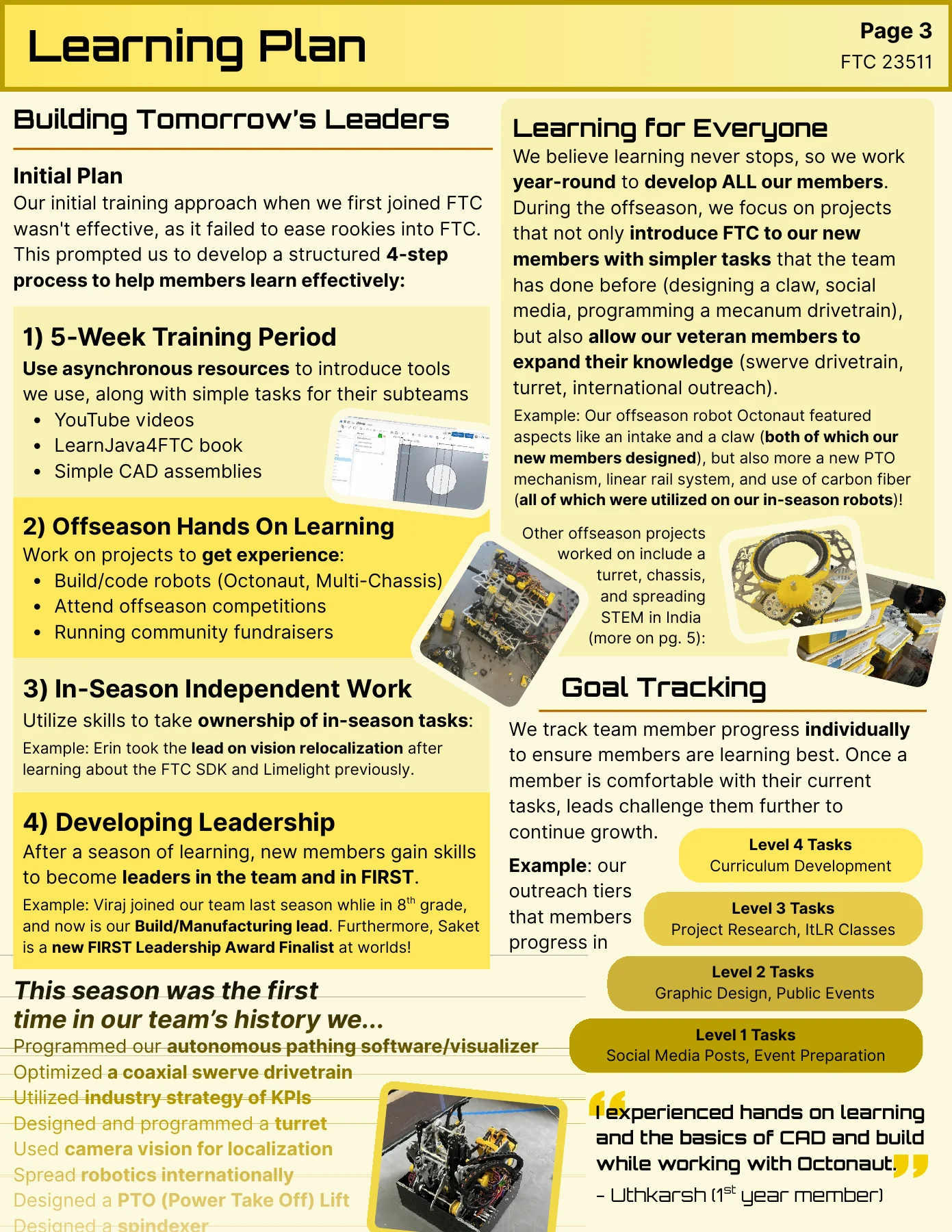
Borrow the progression. For one member, identify the starting skill, practice task, independently completed work, and next responsibility. A training plan can include future steps; mark which stages the member has already reached.
Show where the learning was used
Blu Cru's DECODE page 10 connects a design-mentor discussion with examples of requirements, prototypes, analysis, and manufacturing. It lets readers see the work in which the team applied what it learned.
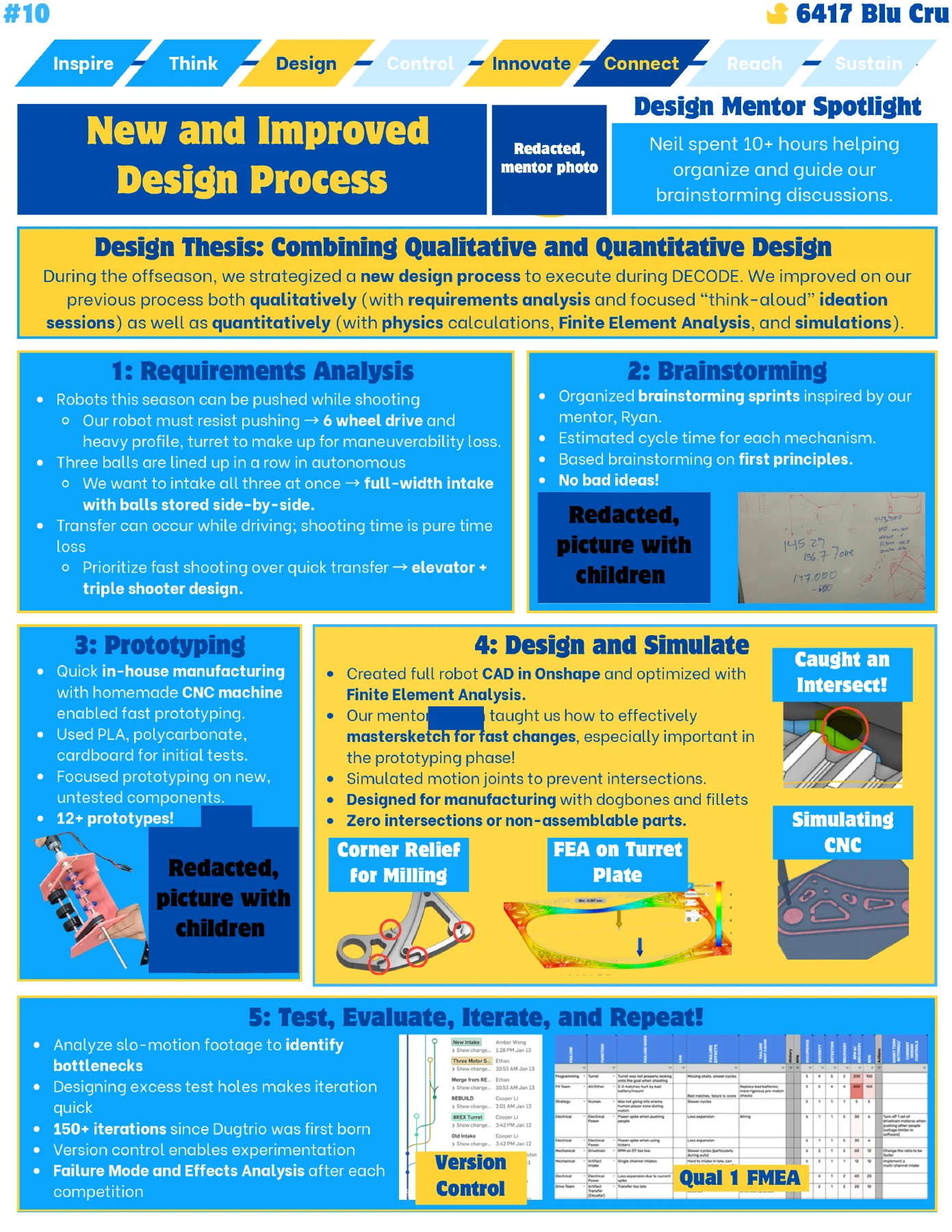
Borrow the connection between advice and action. Explain what students needed to learn, what help they received, and what they then designed, tested, or improved. Keep the mentor's contribution and the students' work distinct and credit both.
STEM partnerships
Explain why you contacted a professional, what they taught you, and how students used the advice. Put a drawing or test result beside the explanation so readers can see the connection.
A may provide money, mentoring, or both. Explain each contribution and credit it accurately. A useful professional relationship does not need to involve sponsorship.
Rebel Robotics' INTO THE DEEP page 6 gives another approach: it pairs professionals with the subjects they helped the team learn, including drawings, wiring documentation, and design review. A reader can understand the purpose of each relationship. Your own explanation can follow one piece of advice into a revised drawing, a test plan, or a part, with a date and student reflection.
Finances
Show where the money comes from, the main expenses, and how you handle a shortfall. Include the currency and dates. Make clear whether an amount is received, promised, spent, or budgeted.
Explain a decision the helped you make, such as changing travel plans, choosing how to manufacture a part, or running a fundraiser. Leave private account details and personal financial information out of the .
A useful budget summary has a period, confirmed income, spending to date, remaining planned costs, and the gap the team still needs to cover. Keep donated parts separate from cash income, and identify the basis of any estimated value. Include the action the team took after reviewing the figures; a chart of expenses alone does not explain how the plan is managed.
Recruitment and handover
Think about which skills and jobs could be lost when members graduate. Show who is learning each job, how they practise, and what they can already do independently.
If you run a feeder program, explain where participants go afterward and what help they continue to receive. Separate what has happened from what you plan to do.
Risks and progress
For Sustain, explain your plan and how you check whether it is working. Leadership training and preparation for problems can strengthen that explanation.
| Problem | What the team is doing | How you can check progress |
|---|---|---|
| Only one person understands | Pair programming and shared setup notes | Another student can set up and run a test |
| The manufacturing lead is graduating | Supervised practice for a successor | The new lead can prepare and check a part independently |
| Event costs are uncertain | A budget, fundraising plan, and spending reviews | Compare money received with expected costs |
| Build deadlines are slipping | Review tasks and adjust the plan | Check completed work against the revised dates |
Use your team's own examples. Explain what you changed when a progress review showed the plan was not working.
Super 7's DECODE page 4 pairs team risks with responses such as roles, training, and progress reviews. Use the same connection in your own plan, then show what has happened since the response was chosen. For a handover, a supervised practice session and an independently completed task are different stages of progress.
Draft a team-development page
Choose a learning or continuity problem that matters to the team this season. Show the starting situation, the plan, a completed action, and the next review. Use a work example, a short progress record, or a budget decision as the main illustration.
Ask a member outside the topic to explain who can now do the task and what remains to be learned. For a future leadership role, explain the preparation underway without presenting the planned handover as already complete.