
Rebel Robotics
The 2025 overall Championship Inspire winner's award overview, design changes, and regional partnerships.
Rebel Robotics, team 18139, won the overall Inspire Award at the 2025 Championship, along with the Franklin Division award. Its INTO THE DEEP makes a large amount of work easy to find, then explains how the developed through the .
Award overview
The first content page introduces the team and robot, groups highlights by award, and gives page references for the longer explanations. can see the main achievements before choosing where to read more.
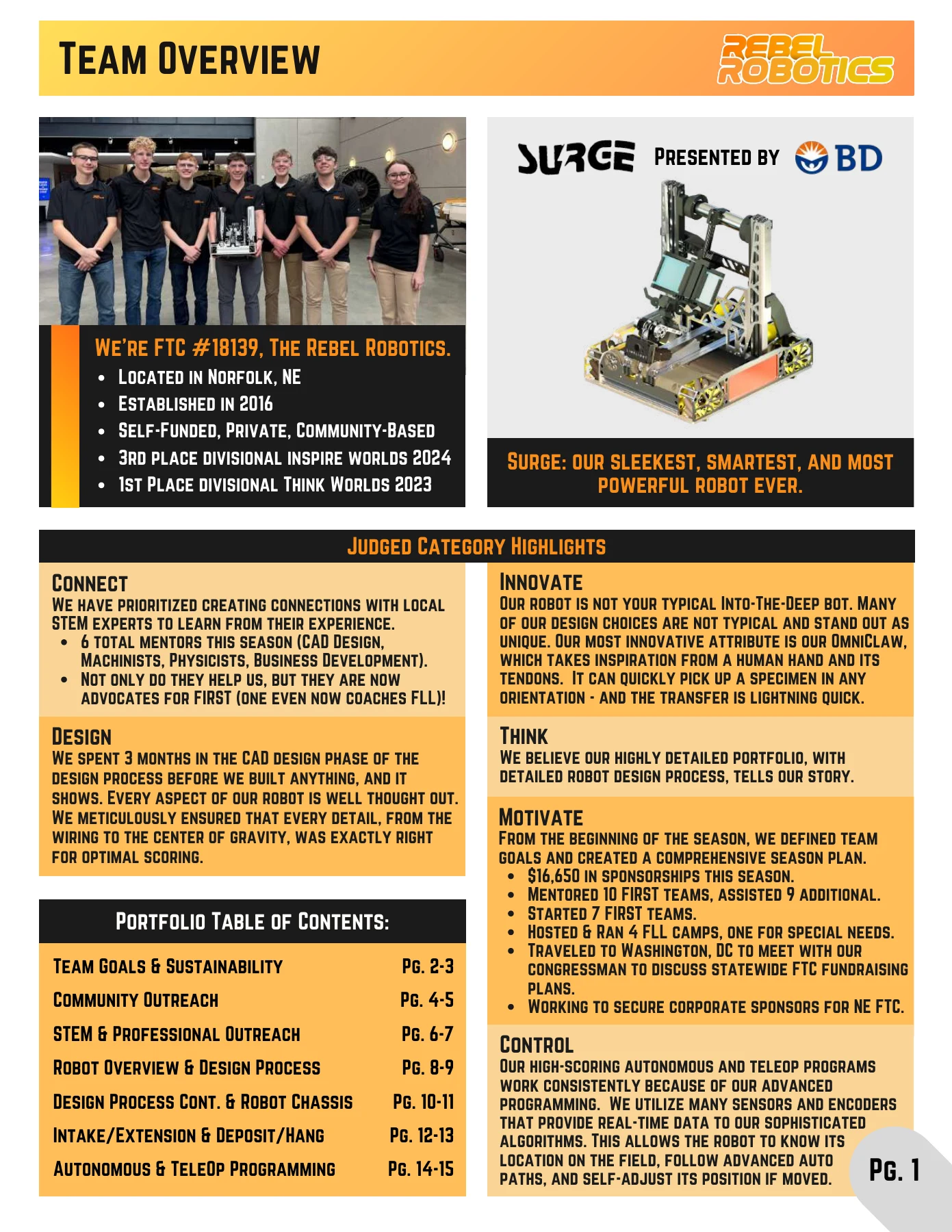
The overview works because the highlights lead somewhere. A short statement about an achievement points to a page with the design, test, or project behind it. You can use that approach to introduce your own team without trying to explain the whole season on the first page.
Check local judging guidance
If your local judging guidance discourages tables of contents or category-highlight pages, use clear topic headings and page references within the explanation instead. Keep the work you want judged on content pages; the cover is for identifying the team.
Robot changes
Pages 9–10 follow the robot from its early competitions to Worlds. Photos of each version sit beside the changes and lessons from that stage. The reader can see the original , understand the pickup and transfer problems, and follow the changes that came next.
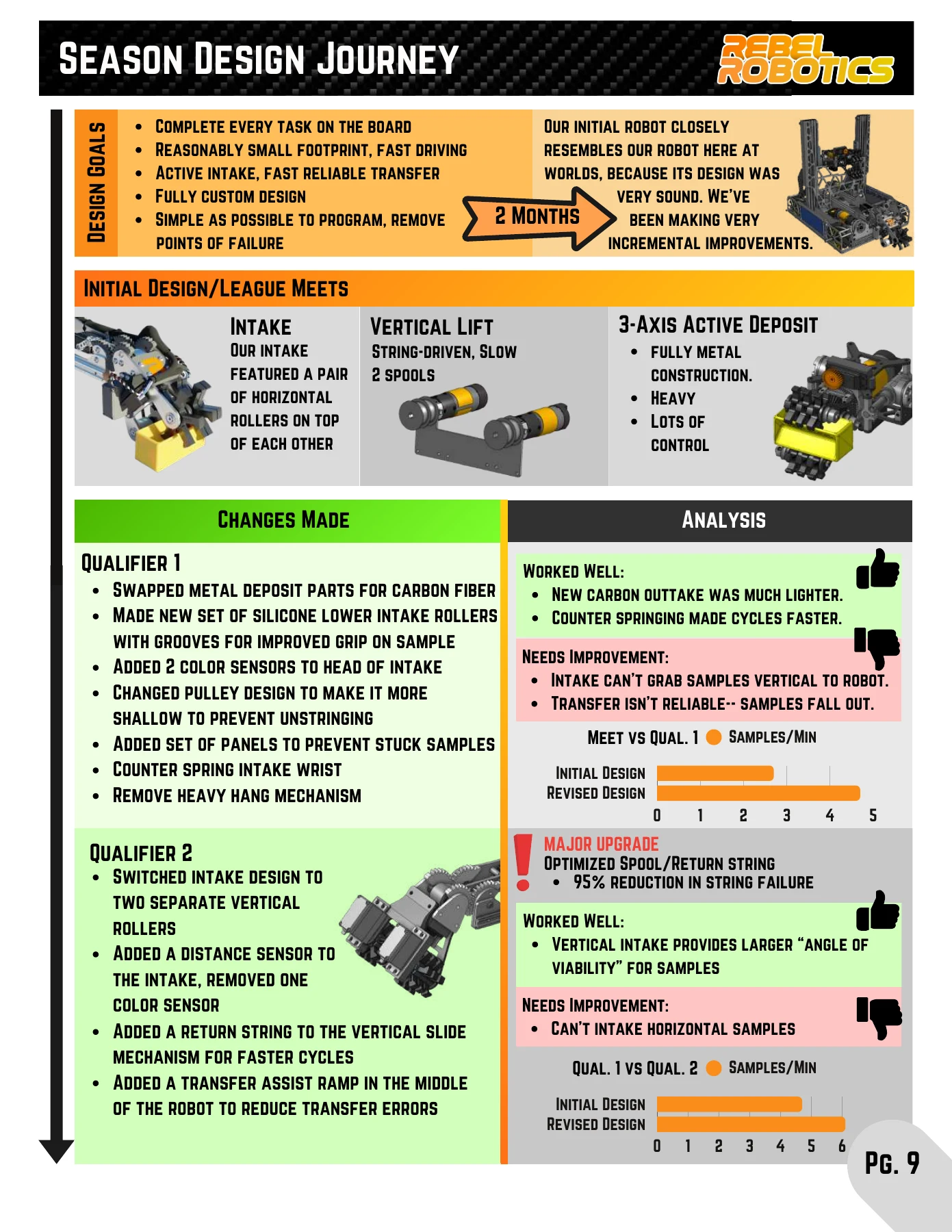
This gives the engineering process a clear order. The team explains what it observed and how that observation affected the next build. Small comparisons beside the designs help the reader follow the team's reasoning.
For your own , save a photo before taking it apart. Put the problem, change, and next test together so readers can follow the same progression.
Follow the lift example
On page 9, find the original string-driven lift, the pulley change, and the later return-string change. Read the team's observations beside the revisions. The continued design journey on page 10 introduces belted slides.
This sequence gives you a useful way to take notes about your own mechanism: identify the original limitation, the physical change, and the observation that prompted another change. Keep speed and string retention as separate questions when comparing your test records. The engineering guide compares this timeline with Super 7's mechanism-by-mechanism layout.
STEM connections
Page 6 describes what professionals helped members learn, including design review, manufacturing drawings, electrical documentation, and mechanism ideas. It pairs those relationships with examples of work, so the reader can see why the team sought each connection.
Pages 4–7 also explain the team's wider regional work with schools, industry, and FIRST leadership. They give different kinds of support their own space rather than reducing every relationship to a logo.
Choose one partnership in your portfolio and show how the advice was used. A drawing, training activity, or revised part can sit beside the explanation of the person's contribution.
Technical illustrations
The mechanism pages use labelled parts, , and close-up views. The reader can locate the feature being discussed while reading why it mattered. The and pages also use routes and control diagrams to explain behavior visually.
Use a full-robot view for context and a close-up for the detail you want to explain. Keep the labels near the relevant part and let the text explain the decision behind it.