
Super 7
The 2026 Edison Division Inspire winner's team risks, recurring outreach, and mechanism comparisons.
Super 7, team 7477, won the Edison Division Inspire Award at the 2026 Championship. Its DECODE uses timelines, project examples, and side-by-side designs to explain the .
Outreach projects
Page 5 gives an overview, while page 6 spends more space on individual projects. The reader gets both the scale of the work and a closer look at what the team did.
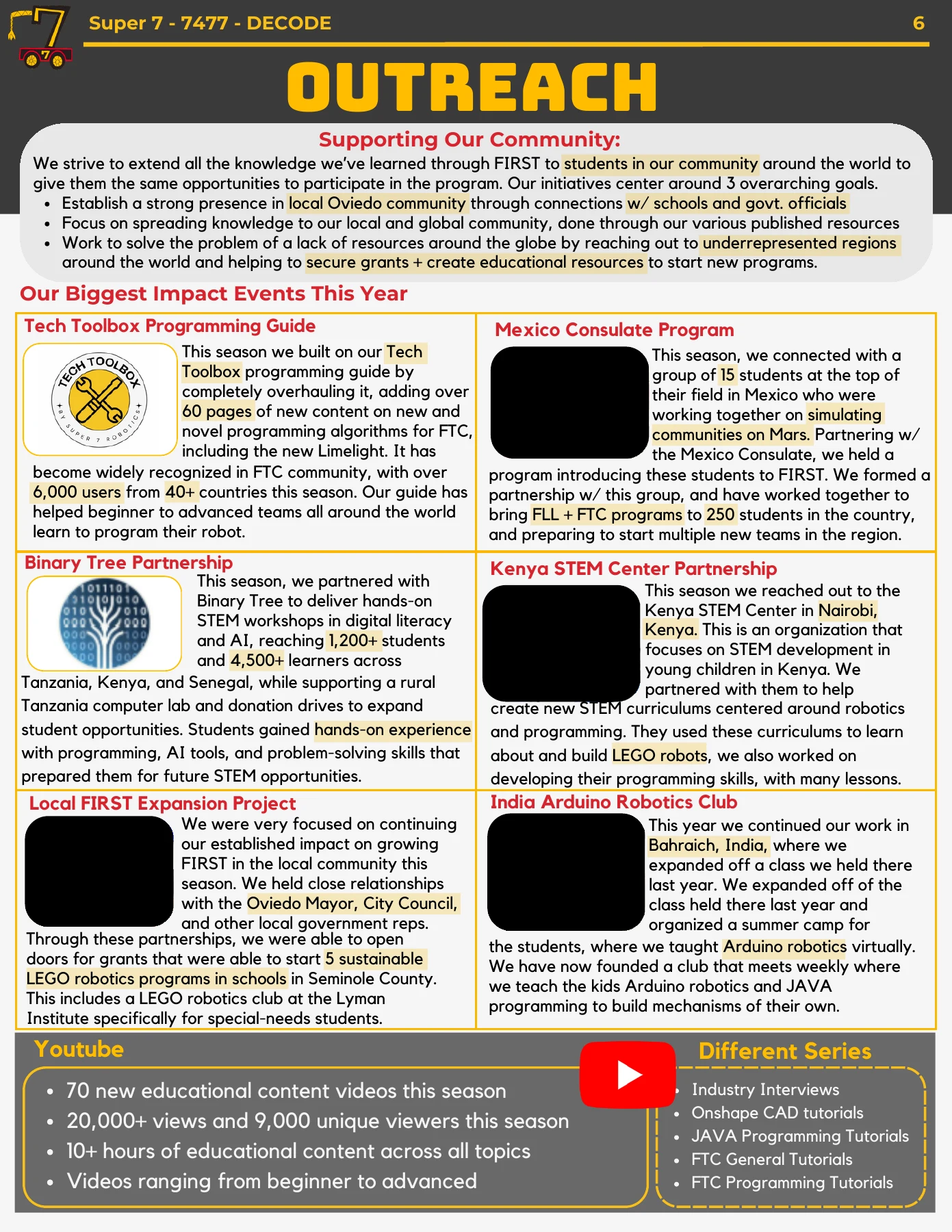
Each project has a name, a short explanation, and a picture or other detail to help the reader place it. Recurring partnerships and published resources can be understood as separate pieces of work.
A timeline can cover your team's smaller activities. Use the space it saves to explain a few projects in more detail: why you chose them, what students did, and what happened afterward.
Design comparisons
Page 12 puts versions of the , shooter, and turret in columns. A reader can compare the same across the page, with pictures and notes about what the team learned at each stage.
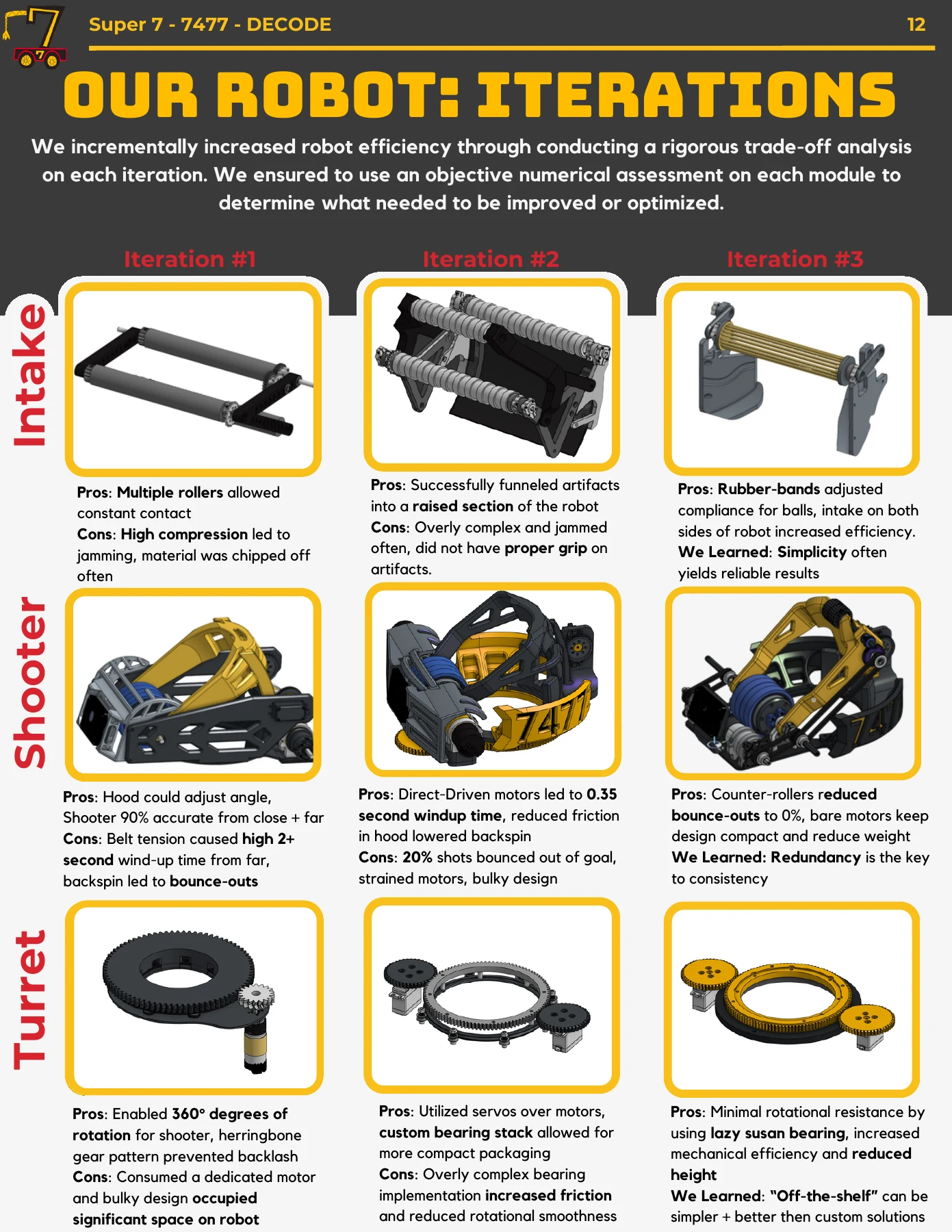
The repeated layout helps the engineering explanation. Instead of searching several pages, readers can move across one row and see how the mechanism changed. The next page develops the indexer investigation in more detail.
Try this for a mechanism that went through several versions. Use the same view and comparison points for each, then explain what prompted the next change.
Read one row closely
Follow the intake row from left to right. Find the compression problem in the first version, the feeding and complexity tradeoff in the second, and the adjustable compliance described in the third. Each observation gives the next design a reason.
Now choose one of your own mechanisms and collect the same three kinds of information: what worked, what still caused trouble, and what you changed next. If a version was never built or tested, label it as an idea or . The engineering lesson shows how to assemble the comparison, while layout and writing explains the alignment that makes it easy to follow.
Team planning
Page 4 pairs problems the team might face with its plans for handling them. These include graduating members, missed deadlines, new recruits, and unavailable . The recruitment and training diagrams show how the team prepares newer members to take responsibility.
A table like this can make a sustainability plan easier to understand. Start with a problem your team actually faces, explain what you are doing about it, and show how you check progress.
Control testing
Page 15 explains a launcher problem: the flywheel slows after a shot, affecting the next one. Before-and-after plots sit beside the controller explanation, with the team reporting recovery time improving from roughly 1.2 seconds to 0.15 seconds.
The page connects the controller to a visible change in the 's behavior. For your own control feature, put the problem, code or control idea, and test result together. That gives readers a reason to care about the algorithm you used.